
Nikon has produced a relatively small variety of lenses for the DX format, most of which are consumer-level zoom lenses. Since 2007, Nikon has announced eight digital SLRs, the D3, D3S, D3X, D700, D800, D800E, D4 and D600 that feature a Nikon FX format sensor that is the size of the 135 film format.
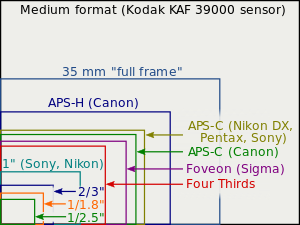
Real sensor size
Nikon uses DX format sensors of slightly different sizes, although all of them are classified as APS-C (crop factor more than 1.3 and less than 1.7):| Camera | Sensor width
(mm) |
Sensor height
(mm) |
Horizontal
pixels |
Vertical
pixels |
Mega
pixels |
||
|---|---|---|---|---|---|---|---|
| Nikon D1 | 23.7 | 15.5 | 2,012 | 1,324 | 2.7 | ||
| Nikon D1H | 23.7 | 15.5 | 2,012 | 1,324 | 2.7 | ||
| Nikon D1X | 23.7 | 15.5 | 3,008 | 1,960 | 5.9 | ||
| Nikon D2H | 23.7 | 15.5 | 2,464 | 1,632 | 4.2 | ||
| Nikon D2Hs | 23.7 | 15.5 | 2,464 | 1,632 | 4.2 | ||
| Nikon D2X | 23.7 | 15.7 | 4,288 | 2,848 | 12.3 | ||
| Nikon D2Xs | 23.7 | 15.7 | 4,288 | 2,848 | 12.3 | ||
| Nikon D40 | 23.7 | 15.5 | 3,008 | 2,000 | 6.0 | ||
| Nikon D40x | 23.7 | 15.6 | 3,872 | 2,592 | 10.1 | ||
| Nikon D50 | 23.7 | 15.5 | 3,008 | 2,000 | 6.0 | ||
| Nikon D60 | 23.6 | 15.8 | 3,872 | 2,592 | 10.1 | ||
| Nikon D70 | 23.7 | 15.5 | 3,008 | 2,000 | 6.0 | ||
| Nikon D70s | 23.7 | 15.5 | 3,008 | 2,000 | 6.0 | ||
| Nikon D80 | 23.6 | 15.8 | 3,872 | 2,592 | 10.1 | ||
| Nikon D90 | 23.6 | 15.8 | 4,288 | 2,848 | 12.3 | ||
| Nikon D100 | 23.7 | 15.5 | 3,008 | 2,000 | 6.1 | ||
| Nikon D200 | 23.6 | 15.8 | 3,872 | 2,592 | 10.1 | ||
| Nikon D300 | 23.6 | 15.8 | 4,288 | 2,848 | 12.3 | ||
| Nikon D300S | 23.6 | 15.8 | 4,288 | 2,848 | 12.3 | ||
| Nikon D3000 | 23.6 | 15.8 | 3,872 | 2,592 | 10.1 | ||
| Nikon D3100 | 23.1 | 15.4 | 4,608 | 3,072 | 14.2 | ||
| Nikon D3200 | 23.2 | 15.4 | 6,016 | 4,000 | 24.2 | ||
| Nikon D5000 | 23.6 | 15.8 | 4,288 | 2,848 | 12.3 | ||
| Nikon D5100 | 23.6 | 15.6 | 4,928 | 3,264 | 16.2 | ||
| Nikon D7000 | 23.6 | 15.6 | 4,928 | 3,264 | 16.2 |
 Lenses for Nikon DX format

- 10.5 mm f/2.8G ED AF DX Fisheye
- 35mm f/1.8G AF-S DX NIKKOR
- 40 mm f/2.8G DX Micro-Nikkor
- 10–24 mm f/3.5-4.5G ED-IF AF-S DX
- 12–24 mm f/4G ED-IF AF-S DX
- 17–55 mm f/2.8G ED-IF AF-S DX[1]
- 18–55mm f/3.5-5.6G ED AF-S DX
- 18–55mm f/3.5-5.6G ED AF-S II DX
- 18-70 mm f/3.5-4.5G ED-IF AF-S DX
- 18–135 mm f/3.5-5.6G ED-IF AF-S DX
- 55-200 mm f/4-5.6G ED AF-S DX
Vibration reduction (VR) lenses in DX format
- 16–85 mm f/3.5-5.6G ED AF-S VR DX
- 18–55 mm f/3.5-5.6G AF-S VR DX
- 18-105 mm f/3.5-5.6G ED-IF AF-S VR DX
- 18-200 mm f/3.5-5.6G ED-IF AF-S VR DX
- 18-200 mm f/3.5-5.6G ED AF-S VR II DX
- 55-200 mm f/4-5.6G ED AF-S VR DX
- 55–300 mm f/4-5.6G ED AF-S VR DX
- 85mm f/3.5 micro ED AF-S VR DX
- 18–300 mm f/3.5-5.6G ED AF-S VR II DX
Implications
The 1/3 smaller diagonal size of the DX format amounts to a 1/3 narrower angle of view than would be achieved with the 135 film format (35mm film or FX format), using a lens of the same focal length. Strictly in angle-of-view terms, the effect is equivalent to increasing focal length by 50% on a 135 film camera, and so is often described as a 1.5× focal length multiplier.This effect can be advantageous for telephoto and macro photography as it produces a tighter crop without the need to increase actual focal length. However it becomes disadvantageous for wide angle photography as a wide angle lens for 135 film effectively becomes a normal lens for the DX format (e.g. 28mm × 1.5 = 42mm 135 film equiv.). This has led to the increased development of the DX format-specific lenses for the Nikon F-mount. Since these lenses do not need to cover the 135 film area, they are smaller and lighter than their 135 format counterparts of equal angle-of-view. The production of DX-specific lenses has also enabled the production of affordable wide angle lenses for the format (e.g., 12mm), whereas costly ultra-wide angle lenses from the 135 format were formerly required.
When DX format lenses are used on 135 format cameras, vignetting often occurs, as the image circle does not cover the entire area of the 135 format.

No comments:
Post a Comment