Monday, November 5, 2012

JSS TRIPLER .profitclicking.com


Rev Up Your Income!

With Profit Clicking there is more than one way to supercharge your income. Our unique traffic exchange system ensures that your brand is turbocharged with the precise traffic it needs to stay in the race!  Simply select the package that suits you, set your advertising budget and watch your website zoom past competitors.

We'll give you the first ten bucks to get your motor running! So, what are you waiting for? Get Your Motor Runnin' Today!


Accelerate Your Earning Potential

For those that want to accelerate their earning potential, Profit Clicking provides a rewarding affiliate program. Our mission is to supply the 98% of marketers that don't traditionally profit online with a virtually unlimited income source.

Our team delights in presenting everyone and anyone, regardless of where you are in the world or what your current financial situation is with a simple, fun and prosperous compensation plan. The best part? You can test drive our system on us!


Kevin Waldron

"...my profit clicking website converts like crazy... grew from 51 referrals to 199 in seven days..."

TRAIN

Types of trains

Four BNSF GE C44-9W diesel locomotives hauling a mixed freight train along the Columbia river, between Kennewick and Wishram, Washington State, USA
 
 
German ICE high speed passenger train (a form of multiple unit)
 
 
Steam locomotive-hauled passenger train
 
 
A train in South Sudan
 
There are various types of trains that are designed for particular purposes. A train can consist of a combination of one or more locomotives and attached railroad cars, or a self-propelled multiple unit (or occasionally a single or articulated powered coach, called a railcar). Trains can also be hauled by horses, pulled by a cable, or run downhill by gravity.
Special kinds of trains running on corresponding special 'railways' are atmospheric railways, monorails, high-speed railways, maglev, rubber-tired underground, funicular and cog railways.
A passenger train may consist of one or several locomotives and coaches. Alternatively, a train may consist entirely of passenger carrying coaches, some or all of which are powered as a "multiple unit". In many parts of the world, particularly the Far East and Europe, high-speed rail is used extensively for passenger travel.
Freight trains are composed of wagons or trucks rather than carriages, though some parcel and mail trains (especially Travelling Post Offices) are outwardly more like passenger trains.
Trains can also be 'mixed', comprising both passenger accommodation and freight vehicles. Such mixed trains are most likely to occur where services are infrequent, and running separate passenger and freight trains is not cost-effective, though the differing needs of passengers and freight usually means this is avoided where possible.
Special trains are also used for track maintenance; in some places, this is called maintenance of way.
In the United Kingdom, a train hauled by two locomotives is said to be "double-headed", and in Canada and the United States it is quite common for a long freight train to be headed by three or more locomotives. A train with a locomotive attached at each end is described as 'top and tailed', this practice typically being used when there are no reversing facilities available. Where a second locomotive is attached temporarily to assist a train up steep banks or grades (or down them by providing braking power) it is referred to as 'banking' in the UK, or 'helper service' in North America. Recently, many loaded trains in the US have been made up with one or more locomotives in the middle or at the rear of the train, operated remotely from the lead cab. This is referred to as "DP" or "Distributed Power."

Terminology

The railway terminology that is used to describe a 'train' varies between countries.
United Kingdom
In the United Kingdom, the interchangeable terms set and unit are used to refer to a group of permanently or semi-permanently coupled vehicles, such as those of a multiple unit. While when referring to a train made up of a variety of vehicles, or of several sets/units, the term formation is used. (Although the UK public and media often forgo 'formation', for simply 'train'.) The word rake is also used for a group of coaches or wagons.
In the United Kingdom Section 83(1) of the Railways Act 1993 defines "train" as follows:
a) two or more items of rolling stock coupled together, at least one of which is a locomotive; or
b) a locomotive not coupled to any other rolling stock.
United States
In the United States, the term consist is used to describe the group of rail vehicles which make up a train. When referring to motive power, consist refers to the group of locomotives powering the train. Similarly, the term trainset refers to a group of rolling stock that is permanently or semi-permanently coupled together to form a unified set of equipment (the term is most often applied to passenger train configurations).
There are three types of trains: Electric, Diesel and Steam.
The Atchison, Topeka and Santa Fe Railway's 1948 operating rules define a train as: "An engine or more than one engine coupled, with or without cars, displaying markers."[2]

Bogies

 
 US-style railroad truck (bogie) with journal bearings
A bogie (play /ˈbɡi/ BOH-ghee) is a wheeled wagon or trolley. In mechanics terms, a bogie is a chassis or framework carrying wheels, attached to a vehicle. It can be fixed in place, as on a cargo truck, mounted on a swivel, as on a railway carriage or locomotive, or sprung as in the suspension of a caterpillar tracked vehicle.

Motive power

The first trains were rope-hauled, gravity powered or pulled by horses. From the early 19th century almost all were powered by steam locomotives. From the 1910s onwards the steam locomotives began to be replaced by less labour intensive and cleaner (but more complex and expensive) diesel locomotives and electric locomotives, while at about the same time self-propelled multiple unit vehicles of either power system became much more common in passenger service. In most countries dieselisation of locomotives in day-to-day use was completed by the 1970s. Steam locomotives are still used in a few where coal and labour are cheap, most notably the People's Republic of China. Steam powered Heritage railways are operated in many countries for the leisure and enthusiast market.
Electric traction offers a lower cost per mile of train operation but at a higher initial cost, which can only be justified on high traffic lines. Since the cost per mile of construction is much higher, electric traction is less viable for long-distance lines with the exception of long-distance high speed lines. Electric trains receive their current via overhead lines or through a third rail electric system.
A recent variation of the electric locomotive is the fuel cell locomotive.[3][4] Fuel cell locomotives combine the advantage of not needing an electrical system in place, with the advantage of emissionless operation. However, the initial cost of such fuel cell vehicles is still substantial at the moment.

Passenger trains

Class 323 at Godley
 
 
Interior of a passenger car in a long-distance train in Finland
 
A passenger train is one which includes passenger-carrying vehicles which can often be very long and fast. It may be a self-powered multiple unit or railcar, or else a combination of one or more locomotives and one or more unpowered trailers known as coaches, cars or carriages. Passenger trains travel between stations or depots, at which passengers may board and disembark. In most cases, passenger trains operate on a fixed schedule and have superior track occupancy rights over freight trains.
Oversight of a passenger train is the responsibility of the conductor. He or she is usually assisted by other crew members, such as service attendants or porters. During the heyday of North American passenger rail travel, long distance trains carried two conductors: the aforementioned train conductor, and a Pullman conductor, the latter being in charge of sleeping car personnel.
Many prestigious passenger train services have been given a specific name, some of which have become famous in literature and fiction. In past years, railroaders often referred to passenger trains as the "varnish", alluding to the bygone days of wooden-bodied coaches with their lustrous exterior finishes and fancy livery. "Blocking the varnish" meant a slow-moving freight train was obstructing a fast passenger train, causing delays.
Some passenger trains, both long distance and short distanced, may use bi-level (double-decker) cars to carry more passengers per train. Car design and the general safety of passenger trains have dramatically evolved over time, making travel by rail remarkably safe.

High-speed rail

One notable and growing long-distance train category is high-speed rail. Generally, high speed rail runs at speeds above 200 km/h (124 mph) and often operates on dedicated track that is surveyed and prepared to accommodate high speeds. Japan's Shinkansen ("bullet-train") commenced operation in 1964, and was the first successful example of a high speed passenger rail system.
The fastest wheeled train running on rails is France's TGV (Train à Grande Vitesse, literally "high speed train"), which achieved a speed of 574.8 km/h (357.2 mph), twice the takeoff speed of a Boeing 727 jetliner, under test conditions in 2007. The highest speed currently attained in scheduled revenue operation is 350 km/h (217 mph) on the Beijing–Tianjin Intercity Rail and Wuhan–Guangzhou High-Speed Railway systems in China. The TGV runs at a maximum revenue speed of 300–320 km/h (186–199 mph), as does Germany's Inter-City Express.
In most cases, high-speed rail travel is time- and cost-competitive with air travel when distances do not exceed 500 to 600 km (311 to 373 mi), as airport check-in and boarding procedures may add as many as two hours to the actual transit time.[5] Also, rail operating costs over these distances may be lower when the amount of fuel consumed by an airliner during takeoff and climbout is considered. As travel distance increases, the latter consideration becomes less of the total cost of operating an airliner and air travel becomes more cost-competitive.
Some high speed rail equipment employs tilting technology to improve stability in curves. Examples of such equipment are the Advanced Passenger Train (APT), the Pendolino, the N700 Series Shinkansen, Amtrak's Acela Express and the Talgo. Tilting is a dynamic form of superelevation, allowing both low- and high-speed traffic to use the same trackage (though not simultaneously, of course), as well as producing a more comfortable ride for passengers.

Maglev

In order to achieve much faster operation over 500 km/h (310 mph), innovative Maglev technology has been researched for years. The Shanghai Maglev Train, opened in 2003, is the fastest commercial train service of any kind, operating at speeds of up to 430 km/h (270 mph). Maglev has not yet been used for inter-city mass transit routes.

Inter-city trains

A New Jersey Transit train (U.S.) arriving at a station.
 
Passenger trains can be divided into three major groups:
  • Intercity trains: connecting cities in the fastest time possible, bypassing all intermediate stations
  • Fast trains: calling at larger intermediate stations between cities, serving large urban communities
  • Regional trains: calling at all intermediate stations between cities, serving all lineside communities
The distinction between the types can be thin or even non-existent. Trains can run as Intercity services between major cities, then revert to a fast or even regional train service to serve communities at the extremity of their journey. This practice allows marginal communities remaining to be served while saving money at the expense of a longer journey time for those wishing to travel to the terminus station.

Regional trains

Regional trains usually connect between towns and cities, rather than purely linking major population hubs like inter-city train, and serve local traffic demand in relatively rural area.

Short-distance trains

Commuter trains

 Mumbai's suburban trains handle 6.3 million commuters daily.[6]
 
 
Interior of a 6-door passenger car in Japan, when the bench seats are folded
 
For shorter distances many cities have networks of commuter trains, serving the city and its suburbs. Trains are a very efficient mode of transportation to cope with large traffic demand in a metropolis. Compared with road transport, it carries many people with much smaller land area and little air pollution.
Some carriages may be laid out to have more standing room than seats, or to facilitate the carrying of prams, cycles or wheelchairs. Some countries have double-decked passenger trains for use in conurbations. Double deck high speed and sleeper trains are becoming more common in mainland Europe.
Sometimes extreme congestion of commuter trains becomes a problem. For example, an estimated 3.5 million passengers ride every day on Yamanote Line in Tokyo, Japan, with its 29 stations. For comparison, the New York City Subway carries 4.8 million passengers per day on 24 services serving 468 stations. To cope with large traffic, special cars in which the bench seats fold up to provide standing room only during the morning rush hour (until 10 a.m.) are operated in Tokyo (E231 series train). In the past this train has included 2 cars with six doors on each side to shorten the time for passengers to get on and off at station.
Passenger trains usually have emergency brake handles (or a "communication cord") that the public can operate. Misuse is punished by a heavy fine.

Long-distance trains

Long-distance trains travel between many cities and/or regions of a country, and sometimes cross several countries. They often have a dining car or restaurant car to allow passengers to have a meal during the course of their journey. Trains travelling overnight may also have sleeping cars. Currently much of travel on these distances of over 500 miles is done by air on many countries but on many others long-distance travel by rail is popular or only cheap way to cross vast distances.

Within cities

Rapid transit

Large cities often have a metro system, also called underground, subway or tube. The trains are electrically powered, usually by third rail, and their railroads are separate from other traffic, usually without level crossings. Usually they run in tunnels in the city centre and sometimes on elevated structures in the outer parts of the city. They can accelerate and decelerate faster than heavier, long-distance trains.
The term rapid transit is used for public transport such as commuter trains, metro and light rail. However, in New York City, services on the New York City Subway have been referred to as "trains".

Tram

In most countries, such as the United Kingdom, the distinction between a tramway and a railway is precise and defined in law. In the US and Canada such street railways are mostly referred to as trolleys. The key difference between a railroad and a trolley system is the latter running primarily on public streets, whereas trains have a right of way separated from the public. Often the US style interurban and modern light rail are confused with a trolley system, as it too may run on on the street for short or medium long sections. In some languages the word tram also refers to interurban and light rail -style networks, in particular Dutch.
The length of a tram or trolley may be determined by national regulations. Germany has the so-called Bo-Strab standard, restricting the length of a tram to 75 metres, while in the US, vehicle length is normally restricted by local authorities, often allowing only a single type of vehicle to operate on the network.

Light rail

The term light rail is sometimes used for a modern tram system, but it may also mean an intermediate form between a tram and a train, similar to a subway except that it may have level crossings. These are then usually protected with crossing gates. In US terminology these systems are often referred to as interurban, as they connect larger urban areas in the vicinity of a major city to that city. Modern light rail systems often use abandoned heavy rail rights of way (e.g. former railway lines) to revitalize deprived areas and redevelopment sites in and around large agglomerations.

Monorail

Monorail was developed to meet medium-demand traffic in urban transit, but represents a relatively small part of the overall railway field.

Named trains

Railway companies often give a name to a train service as a marketing exercise, to raise the profile of the service and hence attract more passengers (and also to gain kudos for the company). Usually, naming is reserved for the most prestigious trains: the high-speed express trains between major cities, stopping at few intermediate stations. The names of services such as the Orient Express, the Flying Scotsman, the Flèche d'Or and the Royal Scot have passed into popular culture.
Some of the popular specially named trains in India are: Brindavan Express (Madras - Bangalore), Deccan Queen (Bombay V.T. - Pune) and Flying Ranee (Bombay Central - Surat).
Certain types of trains also are named in India, such as:
  • Rajdhani Express (National Capital, New Delhi, to a State Capital; fully airconditioned))
  • Duronto Express (Fully airconditioned Non-stop 'Rajdhani' type trains between any two major cities)
  • Garib Rath (Fully airconditioned train with cut-down services and discounted fares for common man)
  • Shatabdi Express (Fully airconditioned short-distanace Intercity Superfast; returns to the originating station by night)
  • Jan Shatabdi Express (An 'economy' version of the Shatabdi Express, with cut-down services and non-aircondioned coaches)
A somewhat less common practice is the naming of freight trains, for the same commercial reasons. The "Condor" was an overnight London-Glasgow express goods train, in the 1960s, hauled by pairs of "Metrovick" diesel locomotives. In the mid-1960s, British Rail introduced the "Freightliner" brand, for the new train services carrying containers between dedicated terminals around the rail network. The Rev. W. Awdry also named freight trains, coining the term The Flying Kipper for the overnight express fish train that appeared in his stories in The Railway Series books.

Other types

Heritage trains
Heritage trains are operated by volunteers, often railfans, as a tourist attraction. Usually trains are formed from historic vehicles retired from national commercial operation.
Airport trains
Airport trains transport people between terminals within an airport complex.
Mine trains
Mine trains are operated in large mines and carry both workers and goods.
Overland trains
Overland trains are used to carry cargo over rough terrain.

Freight trains

Cane train, Australia
 
British electric container freight train
 
American freight service
 
A freight train (also known as goods train) uses freight cars (also known as wagons or trucks) to transport goods or materials (cargo) – essentially any train that is not used for carrying passengers. Much of the world's freight is transported by train, and in the United States the rail system is used more for transporting freight than passengers.
Under the right circumstances, transporting freight by train is highly economic, and also more energy efficient than transporting freight by road. Rail freight is most economic when freight is being carried in bulk and over long distances, but is less suited to short distances and small loads. Bulk aggregate movements of a mere twenty miles (32 km) can be cost effective even allowing for trans-shipment costs. These trans-shipment costs dominate in many cases and many modern practices such as Intermodal container freight are aimed at minimizing these.
The main disadvantage of rail freight is its lack of flexibility. For this reason, rail has lost much of the freight business to road competition. Many governments are now trying to encourage more freight onto trains, because of the benefits that it would bring.
There are many different types of freight trains, which are used to carry many different kinds of freight, with many different types of wagons. One of the most common types on modern railways are container trains, where containers can be lifted on and off the train by cranes and loaded off or onto trucks or ships.
In the U.S. this type of freight train has largely superseded the traditional boxcar (wagon-load) type of freight train, with which the cargo has to be loaded or unloaded manually. In Europe the sliding wall wagon has taken over from the ordinary covered goods wagon.
In some countries "piggy-back" trains or rolling highways are used: In the latter case trucks can drive straight onto the train and drive off again when the end destination is reached. A system like this is used through the Channel Tunnel between England and France, and for the trans-Alpine service between France and Italy (this service uses Modalohr road trailer carriers). "Piggy-back" trains are the fastest growing type of freight trains in the United States, where they are also known as "trailer on flatcar" or TOFC trains. Piggy-back trains require no special modifications to the vehicles being carried. An alternative type of "inter-modal" vehicle, known as a roadrailer, is designed to be physically attached to the train. The original trailers were fitted with two sets of wheels — one set flanged, for the trailer to run connected to other such trailers as a rail vehicle in a train; and one set tyred, for use as the semi-trailer of a road vehicle. More modern trailers have only road wheels and are designed to be carried on specially adapted bogies (trucks) when moving on rails.
There are also many other types of wagons, such as "low loader" wagons for transporting road vehicles. There are refrigerator cars for transporting foods such as ice cream. There are simple types of open-topped wagons for transporting minerals and bulk material such as coal, and tankers for transporting liquids and gases. Today, however, most coal and aggregates are moved in hopper wagons that can be filled and discharged rapidly, to enable efficient handling of the materials.
Freight trains are sometimes illegally boarded by passengers who do not wish to pay money, or do not have the money to travel by ordinary means. This is referred to as "freighthopping" and is considered by some communities[who?] to be a viable form of transport. A common way of boarding the train illegally is by sneaking into a train yard and stowing away in an unattended boxcar; a more dangerous practice is trying to catch a train "on the fly", that is, as it is moving, leading to occasional fatalities. Railroads treat it as trespassing and may prosecute it as such.

KAABA OR KA'BAH


Coordinates: 21.4224945°N 39.8262013°ECoordinates: 21.4224945°N 39.8262013°E
Location Mecca (Makkah), al-Hejaz, Saudi Arabia
Branch/tradition Islam
                                         Architectural information
                                           Height (max) 13.1 m (43 ft)

The Kaaba (Arabic: الكعبةal-Kaʿbah IPA: [ʔælˈkæʕbɐ], "The Cube"), also known as al-Kaʿba(tu) l-Mušarrafah (الكعبة المشرفة; "The Noble Cube"), al-Baytu l-ʿAtīq (البيت العتيق; "The Primordial House"), or al-Baytu l-Ḥarām (البيت الحرام; "The Sacred/Forbidden House") is a cuboid-shaped building in Mecca, Saudi Arabia, and is the most sacred site in Islam.[1]
The building has a mosque (Masjid) built around it, the Masjid al-Haram. All Muslims around the world are supposed to face the Kaaba during prayers, no matter where they are. From any given point in the world, the direction facing the Kaaba is called the Qiblah.
One of the Five Pillars of Islam requires every Muslim to perform the Hajj pilgrimage at least once in his or her lifetime if able to do so. Multiple parts of the Hajj require pilgrims to walk seven times around the Kaaba in a counter-clockwise direction (as viewed from above). This circumambulation, the Tawaf, is also performed by pilgrims during the Umrah (lesser pilgrimage).[1] However, the most dramatic times are during the Hajj, when about 6 million pilgrims gather to circle the building on the same day.[2][3]
The Kaaba is located inside the Masjid al-Ḥarām (المسجد الحرام‎, the "Sacred Mosque") in the center of Mecca (مكة‎ Makkah). It is a cuboid-shape structure which is made of granite quarried from nearby hills. Standing upon a 25 cm (10 in) marble base that projects outwards about 35 cm (14 in).[1] It is approximately 13.1 m (43 ft) high, with sides measuring 11.03 m (36.2 ft) by 12.86 m (42.2 ft).[4][5]
Inside the Kaaba, the floor is made of marble and limestone. The interior walls are clad with marble halfway to the roof. The marble is inset with Qur'anic inscriptions. The wall directly adjacent to the entrance of the Kaaba has six tablets inlaid with inscriptions. The top part of the walls are covered with a green cloth embroidered with gold Qur'anic verses. Caretakers anoint the marble cladding with scented oil used on the Black Stone outside. Three pillars stand inside the Kaaba, with a small altar set between one and the other two. Lamp-like objects (possible crucible censers) hang by a rope above the platform. An enclosed staircase leads to the roof.

Contents

Structures

 
 Drawing of the Kaaba. See key at left for details
 
 
 Technical drawing of the Kaaba showing dimensions and elements
 
 Pilgrims circumambulating the kaaba
Each numbered item in the following list corresponds to features called out in the diagram image.
  1. Al-Ħajaru l-Aswad, "the Black Stone", is located in the Kaaba's eastern corner. Its northern corner is known as the Ruknu l-ˤĪrāqī, "the Iraqi corner", its western as the Ruknu sh-Shāmī, "the Levantine corner", and its southern as Ruknu l-Yamanī "the Yemeni corner".[1][5] The four corners of the Kaaba roughly point toward the four cardinal directions of the compass.[1] Its major (long) axis is aligned with the rising of the star Canopus toward which its southern wall is directed, while its minor axis (its east-west facades) roughly align with the sunrise of summer solstice and the sunset of winter solstice.[6][7]
  2. The entrance is a door set 2.13 m (7 ft) above the ground on the north-eastern wall of the Kaaba, which acts as the façade.[1] In 1979 the 300 kg gold doors made by chief artist Ahmad bin Ibrahim Badr, replaced the old silver doors made by his father, Ibrahim Badr in 1942.[8] There is a wooden staircase on wheels, usually stored in the mosque between the arch-shaped gate of Banū Shaybah and the Zamzam Well.
  3. Rainwater spout made of gold. This was added in the rebuilding of 1627 after the previous year's rain caused three of the four walls to collapse.
  4. Gutter, also added in 1627 to protect the foundation from groundwater.
  5. Hatim, a low wall originally part of the Kaaba. It is a semi-circular wall opposite, but not connected to, the north-west wall of the Kaaba known as the hatīm. This is 90 cm (35 in) in height and 1.5 m (4.9 ft) in width, and is composed of white marble. At one time the space lying between the hatīm and the Kaaba belonged to the Kaaba itself, and for this reason it is not entered during the tawaf. Some believe that the graves of Ismail and his mother Hagar[1] are located in this space. Pilgrims do not walk in the area between this wall and the Kaaba.
  6. Al-Multazam, the part of the wall between the Black Stone and the entry door.
  7. The Station of Abraham, a glass and metal enclosure with what is said to be an imprint of Abraham's foot. Abraham is said to have stood on this stone during the construction of the upper parts of the Kaaba, raising Ismail on his shoulders for the uppermost parts.[9]
  8. Corner of the Black Stone (East).
  9. Corner of Yemen (South-West). Pilgrims traditionally acknowledge a large vertical stone that forms this corner.
  10. Corner of Syria (North-West).
  11. Corner of Iraq (North-East).
  12. Kiswa, the embroidered covering. Kiswa is a black silk and gold curtain which is replaced annually during the Hajj pilgrimage.[10][11] Two-thirds of the way up is a band of gold-embroidered Quranic text, including the Shahada, the Islamic declaration of faith.
  13. Marble stripe marking the beginning and end of each circumperambulation.
  14. The station of Gabriel.[12]

Religious significance

 Masjid al-Haram and Kaaba during Hajj, 2008

Qiblat

The Qibla is the Muslims name for the direction faced during prayer.[Quran 2:143–144] It is the focal point for prayer. The direction faced during prayer is the direction of where the Kaaba is.

Pilgrimage

The Haram is the focal point of the Hajj and Umrah pilgrimages[13] that occur in the month of Dhu al-Hijjah in the Islamic calendar and at any time of the year, respectively. The Hajj pilgrimage is one of the Pillars of Islam, required of all able-bodied Muslims who can afford the trip. In recent times, about 3 million Muslims perform the Hajj every year.
Some of the rituals performed by pilgrims are symbolic of historical incidents. For example, the episode of Hagar's search for water is emulated by Muslims as they run between the two hills of Safa and Marwah whenever they visit Mecca.
The Hajj is associated with the life of the Islamic prophet Muhammad from the 7th century, but the ritual of pilgrimage to Mecca is considered by Muslims to stretch back thousands of years to the time of Sayyidna Ibrahim (Abraham).

History

 
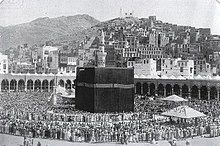
 Kaaba in 1907
According to Islamic tradition the Kaaba was re-constructed by Abraham. It is stated in the Qur'an that this was the first house that was built for humanity to worship Allah.

Pre-Islamic era

The early Arabian population consisted primarily of warring nomadic tribes. When they did converge peacefully, it was usually under the protection of religious practices.[14] Writing in the Encyclopedia of Islam, Wensinck identifies Mecca with a place called Macoraba mentioned by Ptolemy. His text is believed to date from the second century AD, about 400 years before the coming of Muhammad,[15] and described it as a foundation in southern Arabia, built around a sanctuary. It probably did not become an area of religious pilgrimage until around 500 A.D. It was then that the Quraysh tribe (into which Muhammad was later born) took control of Macoraba and made an agreement with the local kinanah Bedouins for possession.[16] The sanctuary itself, located in a barren valley surrounded by mountains, was probably built at the location of the water source today known as the Zamzam Well, an area of considerable religious significance to Muslims.
In her book, Islam: A Short History, Karen Armstrong asserts that the Kaaba was dedicated to Hubal, a Nabatean deity, and contained 360 idols that either represented the days of the year[17] or were effigies of the Arabian pantheon. Once a year, tribes from all around the Arabian peninsula, whether Christian or pagan, would converge on Mecca to perform the Hajj.
Imoti[18] contends that there were multiple such "Kaaba" sanctuaries in Arabia at one time, but this was the only one built of stone. The others also allegedly had counterparts of the Black Stone. There was a "red stone", the deity of the south Arabian city of Ghaiman, and the "white stone" in the Kaaba of al-Abalat (near the city of Tabala, south of Mecca). Grunebaum in Classical Islam points out that the experience of divinity of that period was often associated with stone fetishes, mountains, special rock formations, or "trees of strange growth."[19] The Kaaba was thought to be at the center of the world, with the Gate of Heaven directly above it. The Kaaba marked the location where the sacred world intersected with the profane; the embedded Black Stone was a further symbol of this as a meteorite that had fallen from the sky and linked heaven and earth.[20]
According to Sarwar,[21] about 400 years before the birth of Muhammad, a man named "Amr bin Lahyo bin Harath bin Amr ul-Qais bin Thalaba bin Azd bin Khalan bin Babalyun bin Saba", who was descended from Qahtan and was the king of Hijaz (the northwestern section of Saudi Arabia, which encompassed the cities of Mecca and Medina), had placed a Hubal idol onto the roof of the Kaaba. This idol was one of the chief deities of the ruling Quraysh. The idol was made of red agate and shaped like a human, but with the right hand broken off and replaced with a golden hand. When the idol was moved inside the Kaaba, it had seven arrows in front of it, which were used for divination.[citation needed]
To maintain peace among the perpetually warring tribes, Mecca was declared a sanctuary where no violence was allowed within 20 miles (32 km) of the Kaaba. This combat-free zone allowed Mecca to thrive not only as a place of pilgrimage, but also as a trading center.[22]
Edward Gibbon suggested that the Kaaba was mentioned by ancient Greek writer, Diodorus Siculus, before the Christian era:
The genuine antiquity of Caaba ascends beyond the Christian era: in describing the coast of the Red sea the Greek historian Diodorus has remarked, between the Thamudites and the Sabeans, a famous temple, whose superior sanctity was revered by all the Arabians; the linen of silken veil, which is annually renewed by the Turkish emperor, was first offered by the Homerites, who reigned seven hundred years before the time of Mohammad.
—Edward Gibbon,  Decline And Fall Of The Roman Empire, Volume V, pp. 223–224
Gibbon, however, had misinterpreted Siculus's text. Siculus described the location of this temple as being on a bay that extends deep inland to a distance of about 500 stades (about 80 km), and that the entrance of this bay is obstructed by a rock extending into the sea. Here is the description from Diodorus Siculus:
Next after these plains as one skirts the coast comes a gulf of extraordinary nature. It runs, namely, to a point deep into the land, extends in length a distance of some five hundred stades, and shut in as it is by crags which are of wondrous size, its mouth is winding and hard to get out of; for a rock which extends into the sea obstructs its entrance and so it is impossible for a ship either to sail into or out of the gulf. Furthermore, at times when the current rushes in and there are frequent shiftings of the winds, the surf, beating upon the rocky beach, roars and rages all about the projecting rock. The inhabitants of the land about the gulf, who are known as Banizomenes, find their food by hunting the land animals and eating their meat. And a temple has been set up there, which is very holy and exceedingly revered by all Arabians.
—Diodorus Siculus,  Bibliotheca Historica volume iii.44, p. 217
There is no bay that matches this description along the coast near Mecca. Furthermore, Siculus describes this area as lying between the Thamudites and the Nabataeans, not the Thamudites and the Sabeans as Gibbon erroneously stated, which would put it much farther to the north, around the area of Tabuk. It is widely believed that this bay and temple described by Diodorus is in fact the bay adjacent to Ash-Sharmah in Tabuk Province.[23]
In Makkan Trade and the Rise of Islam, Patricia Crone argues that the identification of Macoraba with Mecca is false and that Macoraba was a town in southern Arabia in what was then known as Arabia Felix.[24]
Crone was responded to by Dr. Amaal Muhammad Al-Roubi in his book "A Response to Patrica Crone's book".[25][26]
G. E. von Grunebaum says,
Mecca is mentioned by Ptolemy. The name he gives it allows us to identify it as a South Arabian foundation created around a sanctuary.
—G. E. Von Grunebaum,  Classical Islam: A History 600–1258, p. 19
Many Muslim and academic historians stress the power and importance of the pre-Islamic Mecca. They depict it as a city grown rich on the proceeds of the spice trade. Crone believes that this is an exaggeration and that Mecca may only have been an outpost trading with nomads for leather, cloth, and camel butter. Crone argues that if Mecca had been a well-known center of trade, it would have been mentioned by later authors such as Procopius, Nonnosus, or the Syrian church chroniclers writing in Syriac. The town is absent, however, from any geographies or histories written in the three centuries before the rise of Islam.[27]
According to the Encyclopædia Britannica, "before the rise of Islam it was revered as a sacred sanctuary and was a site of pilgrimage."[28] According to German historian Eduard Glaser, the name "Kaaba" may have been related to the southern Arabian or Ethiopian word "mikrab", signifying a temple.[15] Again, Crone disputes this etymology.

Construction by Abraham and Ishmael

 
 Left: Conceptual representation of the Kaaba, as built by Ibrahim. Right: Representation of the Kaaba as it stands today
The Quran states that Ibrahim, together with his son Ishmael, raised the foundations of the holy house.[Quran 2:127] God had shown Ibrahim the exact site, very near to the Well of Zamzam, where Ibrahim and Ishmael began work on the Kaaba's construction in circa 2130 BCE.[29] After Ibrahim had built the Kaaba, an angel brought to him the Black Stone, a celestial stone that, according to tradition, had fallen from Heaven on the nearby hill Abu Qubays.[30] According to a saying attributed to Muhammad, the Black Stone had "descended from Paradise whiter than milk but the sins of the sons of Adam had made it black".[31] The Black Stone is believed to be the only remnant of the original structure made by Ibrahim. But it is not known whether they actually built it (Ibrahim supposedly did not go near Mecca).
After the placing of the Black Stone in the Eastern corner of the Kaaba, Ibrahim received a revelation, in which God told the aged prophet that he should now go and proclaim the pilgrimage to mankind, so that men may come both from Arabia and from lands far away, on camel and on foot.[Quran 22:27] Going by the dates attributed to the patriarchs, Ishmael is believed to have been born in roughly 2150 BCE, with Isaac being born a hundred years later.[30] Therefore, Islamic scholars have generally assumed that the Kaaba was constructed by Ibrahim around 2130 BCE. The Kaaba is, therefore, believed by Muslims to be more than a millennium older than Solomon's Temple in Jerusalem, which is believed to have been finished in 1007 BCE.[30] These dates remain consistent with the Muslim belief that the Kaaba is the first and thus oldest mosque in history.[30]

Muhammad era

At the time of Muhammad (CE 570–632 A.D), his tribe, the Quraysh, was in charge of the Kaaba, which was at that time a shrine containing hundreds of idols representing Arabian tribal gods and other religious figures. Muhammad earned the enmity of his tribe by claiming the Kaaba to be dedicated to the worship of Allah alone and by having all the other idols evicted. The Quraysh persecuted and harassed him continuously,[citation needed] so he and his followers eventually migrated to Medina in 622.
Islamic histories also mention a reconstruction of the Kaaba around 600 A.D. A story found in Ibn Ishaq's Sirat Rasūl Allāh, one of the biographies of Muhammad (as reconstructed and translated by Guillaume), describes Muhammad settling a quarrel between Meccan clans as to which clan should set the Black Stone cornerstone in place. According to Ishaq's biography, Muhammad's solution was to have all the clan elders raise the cornerstone on a cloak, after which Muhammad set the stone into its final place with his own hands.[32][33] Ibn Ishaq says that the timber for the reconstruction of the Kaaba came from a Greek ship that had been wrecked on the Red Sea coast at Shu'ayba and that the work was undertaken by a Coptic carpenter called Baqum.[34]
After this migration, or Hijra, the Muslim community became a political and military force, continuously repelling Meccan attacks. In 630 A.D, two years after signing the Treaty of Hudaybiyyah, the Meccan Quraysh attacked the Bedouin Khuza'a, thereby breaking the peace treaty. The Muslims emerged as victors in the battle that followed this incident and Muhammad entered Mecca with his followers; they proceeded to the Kaaba. He refused, however, to enter the Kaaba while there were idols in it and so sent Abu Sufyan ibn Harb and Mughira ibn Shu'ba to remove them.[35][36][37]
Narrated Ibn Abbas: When Allah's Apostle arrived in Mecca, he refused to enter the Ka'ba while there were idols in it. So he ordered that they be taken out. The pictures of the (Prophets) Ibrahim and Ishmael, holding arrows of divination in their hands, were carried out. The Prophet said, "May Allah ruin them (i.e. the infidels) for they knew very well that they (i.e. Ibrahim and Ishmael) never drew lots by these (divination arrows). Then the Prophet entered the Ka'ba and said. "Allahu Akbar" in all its directions and came out and not offer any prayer therein.
Sahih Al-BukhariBook 59, Hadith 584
The Kaaba was re-dedicated as an Islamic house of worship and henceforth the annual pilgrimage was to be a Muslim rite, the Hajj, with visits to the Kaaba and other sacred sites around Mecca.[38]
It is also the birthplace of ʿAlī ibn Abī Tālib, the fourth caliph and cousin and son-in-law of the Islamic prophet Muhammad.[38]

After Muhammad

 
 The site of Kaaba in 1880
The Kaaba has been repaired and reconstructed many times since Muhammad's day. The Umayyads, during the last days of Yazid ibn Muawiya destroyed the Kaaba in Muharram 64 (Hijri date, 683 A.D.) and before the next Hajj Abd-Allah ibn al-Zubayr, an early Muslim who ruled Mecca for many years between the death of ʿAli and the consolidation of Ummayad power, rebuilt it to include the hatīm.[39] He did so on the basis of a tradition (found in several hadith collections[40]) that the hatīm was a remnant of the foundations of the Abrahamic Kaaba, and that Muhammad himself had wished to rebuild so as to include it.
This structure was destroyed (or partially destroyed) in 683 A.D., during the war between Abd Allah ibn al-Zubayr and Umayyad forces commanded by Al-Hajjaj bin Yousef. Al-Hajjaj used stone-throwing catapults against the Meccans.
The Ummayads under ʿAbdu l-Malik ibn Marwan finally reunited all the former Islamic possessions and ended the long civil war. In 693 A.D he had the remnants of al-Zubayr's Kaaba razed, and rebuilt on the foundations set by the Quraysh.[41] The Kaaba returned to the cube shape it had taken during Muhammad's time.
During the Hajj of 930 A.D, the Qarmatians attacked Mecca, defiled the Zamzam Well with the bodies of pilgrims and stole the Black Stone, taking it to the oasis region of Eastern Arabia known as al-Aḥsāʾ, where it remained until the Abbasids ransomed it in 952 A.D. The basic shape and structure of the Kaaba have not changed since then.[42]
After heavy rains and flooding in 1629, the walls of the Kaaba collapsed and the Masjid was damaged. The same year, during the reign of Murad IV, the Kaaba was rebuilt with granite stones from Mecca and the Masjid was renovated.[43] The Kaaba's appearance has not changed since then.
The Kaaba is depicted on the reverse of 500 Saudi Riyal, and the 2000 Iranian rial banknotes.[44]

Cleaning

 
 The Kaaba during Hajj
The building is opened twice a year for a ceremony known as "the cleaning of the Ka'ba." This ceremony takes place roughly thirty days before the start of the month of Ramadan and thirty days before the start of Hajj.
The keys to the Ka'aba are held by the Banī Shayba (بني شيبة) tribe. Members of the tribe greet visitors to the inside of the Kaaba on the occasion of the cleaning ceremony. A small number of dignitaries and foreign diplomats are invited to participate in the ceremony.[45] The governor of Mecca leads the honoured guests who ritually clean the structure, using simple brooms. Washing of the Ka'ba is done with a mixture of water from the Zamzam Well and Persian rosewater.[46]